Features of the Laboratory
In our laboratory, we conduct experimental research driven by the question: “How and why do the behaviors and properties of living systems differ from those of inanimate matter?” Some students may wonder, “Why study living systems in a physics department?” Indeed, for a long time, it was questioned whether living organisms obey physical laws, and it was widely believed that the essence of “lifelike” behavior could not be understood scientifically.Today, however, such views are largely relics of the early 20th century. In the now rapidly developing field of biophysics, many scientists are actively tackling this problem from diverse perspectives.
Biophysics is a relatively young field that explores familiar phenomena
occurring within our own bodies. Through a wide variety of approaches,
researchers have been deepening our understanding of the fundamental question:
“What is life?” Because the field does not necessarily require extensive
prior knowledge or highly specialized training, it is not the case that
one must pursue a doctoral degree simply to engage with cutting-edge research.
In fact, several students in our laboratory have presented their findings
from undergraduate research at international conferences, published papers
in peer-reviewed journals, and received academic awards.
Research Overview
Machines created by humans are typically composed of rigid materials such as metals, plastics, and semiconductors. Because these materials rarely change their properties or functions in response to external environmental fluctuations, it is possible to design machines by predicting their collective behavior from the properties of individual components.In contrast, the tissues that make up our bodies consist of much softer and more deformable materials—such as gels, colloids, and lipid membranes—collectively referred to as soft matter. These materials can exhibit a wide variety of responses even to small external perturbations or energy inputs.
Remarkably, biological systems composed of such soft materials are capable of far more sophisticated functions than the machines we construct.Within the microscopic space of a cell—the fundamental unit of life—numerous organelles made of soft matter (including components analogous to parts, machines, factories, transport pathways, and power sources) are densely packed and constantly interacting. While these organelles strongly influence one another, they are also individually operated by molecular-scale engines known as motor proteins, enabling them to perform their specific functions. The complex structural organization inside cells is itself a dissipative structure, formed through the continuous injection of mechanical energy into the system by these molecular motors.Soft matter under such “complex nonequilibrium conditions” gives rise to the rich variety of biological activities observed both inside and outside cells. However, the materials-science-based understanding of these behaviors is still in its infancy, and much remains unknown. Our goal is to deepen the physical understanding of life phenomena by designing and performing experiments that explore the physical principles governing the diverse nonequilibrium behaviors of biological soft matter.
To this end, our laboratory employs:1. living cultured cells and biological
tissues, and2. simplified and controllable model systems that mimic essential
aspects of biological systems.Using these approaches, we investigate how
nonequilibrium behaviors of soft matter give rise to “lifelike” properties.
For example, we utilize techniques that allow precise application of forces
to individual molecules or microparticles, as well as manipulation of their
positions (such as optical trapping and atomic force microscopy). By creating
artificially controlled nonequilibrium environments in microscopic spaces,
we observe and analyze the resulting behaviors.
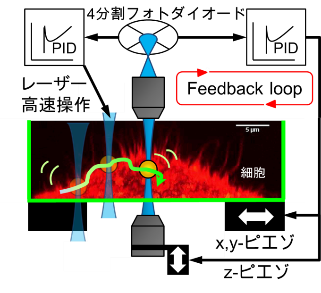 細胞内非平衡力学計測装置 細胞内非平衡力学計測装置 |
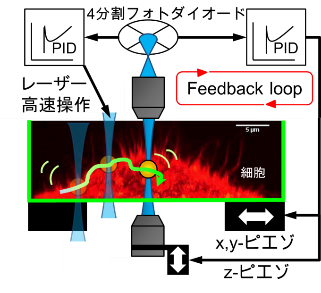 一分子非平衡ダイナミクス計測装置 一分子非平衡ダイナミクス計測装置 |