0. Introduction
Living system is the collective organization of soft-matter components,
such as biomacromolecules and lipid membranes, coupled through complex
networks of chemical reactions. These interactions give rise to remarkable
properties—including self-reproduction and evolution—that distinguish living
systems from ordinary matter. My research seeks to uncover the physical principles underlying this emergence of life by taking a bottom-up approach rooted in soft-matter physics and materials
science.
-
Fig.1: Lipid vesicles
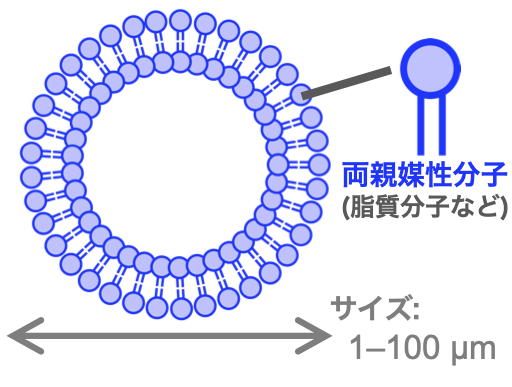
A central focus of my work is one of the most fundamental characteristics
of life: self-reproduction. To study this process in its simplest form,
I use lipid vesicles (Fig.1)—microscopic membrane compartments that can be regarded as simplified
models of cells. By combining the physics of membrane deformation and division
with chemical reaction systems that drive membrane growth, I have tried
to construct synthetic minimall cells with the reproduction ability. Based
on the model experimental systems, I aim to clarify the principles by which
soft matter self-organizes into living systems.
Since joining Kyushu University, I have expanded my research beyond model
cell membranes to investigate the dynamic physical properties of the cytoplasm,
the complex interior of living cells. My long-term goal is to understand the cell as an integrated physical system,
encompassing both its membrane and its interior. Ultimately, I hope to contribute to a physics-based understanding of
how nonliving matter organizes into living systems, and to deepen our understanding
of what it fundamentally means for matter to become alive.
1. Bottom-up Artificial Cells
One of the greatest challenges in understanding life is its overwhelming complexity. Living cells consist of enormous numbers of molecules and intricate reaction networks, making it difficult to distinguish which features are fundamental to life and which are merely consequences of the particular molecular machinery used by modern organisms. From the viewpoint of physics, I am interested in identifying universal principles of living systems, rather than explanations that depend on specific molecules such as DNA or proteins.
To address this question, I adopted a bottom-up approach: instead of reconstructing biological cells, I designed artificial molecular systems intentiousing components and reaction schemes that differ as much as possible from those found in nature. The goal was to reproduce the essential properties of life—especially reproduction—in the simplest possible experimental system.
-
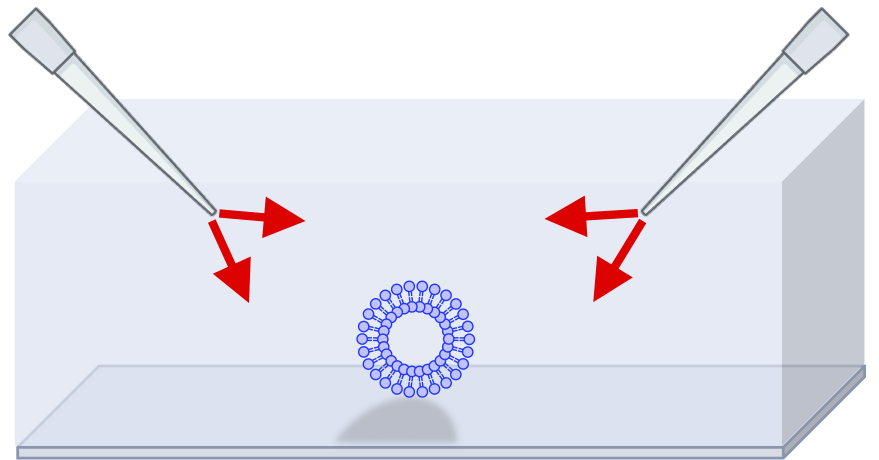
Fig.2: Supplying reactants
-
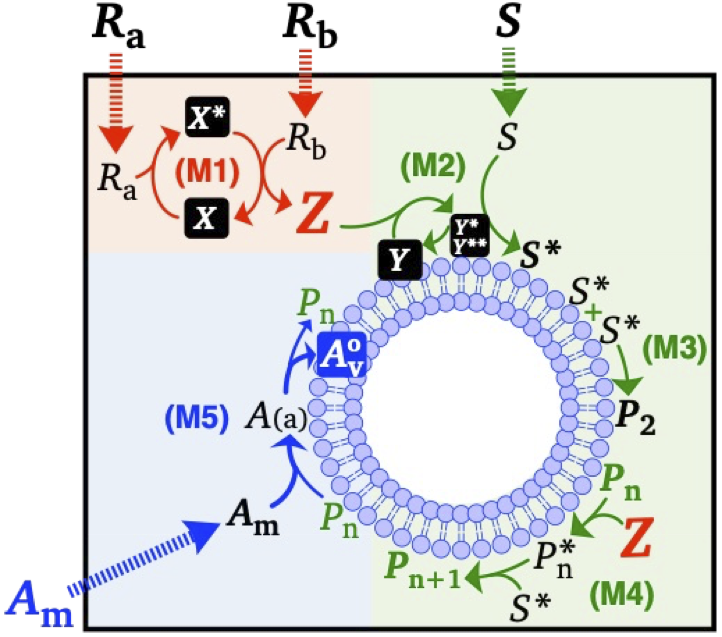
Fig.3: Reaction pathways drive vesicle growth
My research focuses on lipid vesicles, which serve as simplified cell-like
compartments. In collaboration with Prof. Masayuki Imai and Prof. Peter
Walde, I combined membrane mechanics with supramolecular chemistry and
chemical reaction networks to construct a synthetic minimal cell. In this
system, reactant molecules and amphiphiles were supplied by microinjection
devices to a target vesicle (Fig.2). Catalytic polymers synthesized on the vesicle surface promote membrane
growth by the uptake of additional amphiphiles, while membrane growth in
turn provides the reaction field for further polymer production (Fig.3). This mutually catalytic feedback enables accelerated vesicle growth
under a constant supply of materials.
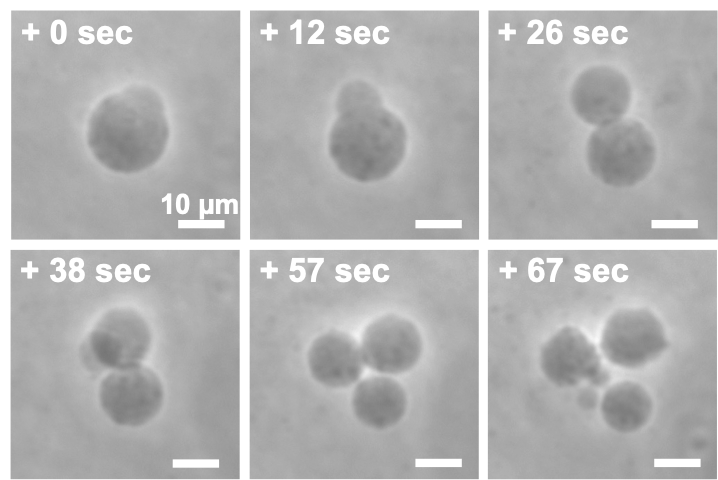
By tuning the membrane composition based on membrane elasticity theory,
growing vesicles spontaneously deform and divide repeatedly. As a result,
we successfully developed a synthetic minimal cell system capable of spontaneous
reproduction over four to five generations using a remarkably simple set
of molecular components (Fig.4 & Movie).
-
Fig.4: Reproduction of synthetic minimal cell
An important advantage of this minimal system is its quantitative describability.
Because every molecular component and reaction is explicitly defined, the
entire system can be described using physical models, including reaction
kinetics, membrane elasticity, and chemical potential–driven membrane growth.
This close connection between experiment and theory makes artifici minimal cells a powerful platform for exploring the physical
principles that bridge nonliving matter and living systems.
Today, this work has expanded toward broader questions surrounding the
Life-Nonlife Transition. Together with researchers in theoretical physics, soft matter, and biology,
I am investigating how self-organizing molecular systems acquire life-like
properties, and whether processes beyond reproduction—such as evolution—can
ultimately emerge from simple physical systems. My long-term goal is to
understand how living systems arise from nonliving matter and to establish
a physics-based framework for describing this fundamental transition.
Related articles:
Kurisu et al., "Synthesising a minimal cell with artificial metabolic pathways",
Communications Chemistry 6, 56 (2023).
Kurisu et al., "Reproduction of vesicles coupled with a vesicle surface-confined enzymatic
polymerisation", Communications Chemistry 2, 117 (2019).
Kurisu et al., "Vesicle-surface-templated catalytic polymers drive
differential growth in synthetic minimal cell variants" (submitted).
2. General Microcompartment for Proliferation
Artificial cells are typically constructed by encapsulating functional molecules or biochemical reactions inside lipid vesicles. While considerable effort has been devoted to engineering increasingly sophisticated molecular functions, the membrane compartment itself is often treated as a passive container. I have been interested in a complementary question: Can we develop a generic compartment that autonomously proliferates, regardless of its internal contents? Such a platform could provide a simple way to endow a wide variety of artificial cells with the ability of reproduction without redesigning their internal molecular machinery.
-
Fig.5 Asymmetry in permeability
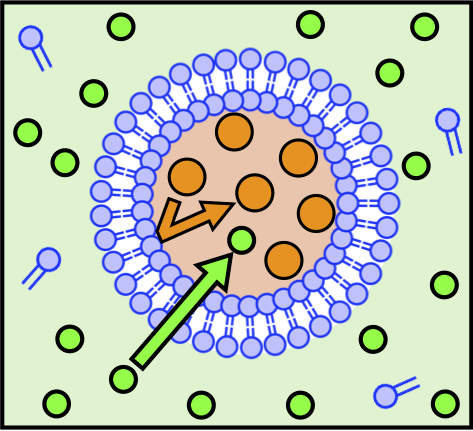
To this end, I discovered a remarkably simple vesicle system that undergoes
spontaneous and recursive budding division. The system requires only a two-component membrane and an osmotic asymmetry
between the inside and outside of the vesicle (Fig.5). Vesicles repeatedly exhibit budding and fission through a purely physical
mechanism, without relying on enzymes or biochemical reaction networks.
We named this phenomenon the Osmotic Spawning Vesicle (OS Vesicle).
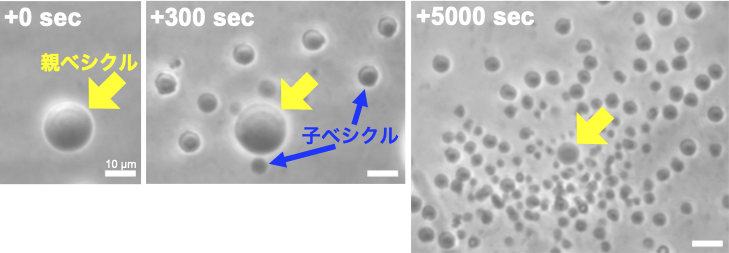
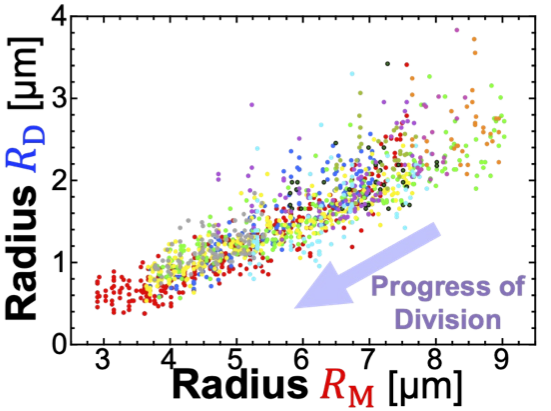
A striking feature of OS vesicles is their prolific reproduction. A single mother vesicle can generate tens to hundreds of daughter vesicles through repeated budding events (Fig.6 & Movie). Moreover, the daughter vesicles are not produced at random sizes; instead,
their size is reproducible and largely determined by the size of the parent
vesicle (Fig.7). This intrinsic size control can be quantitatively explained using membrane
elasticity theory.
-
Fig.6: A mother vesicle spontaneously generate 30-300 daughters
-
Fig.7: Mother vs daughter radii
Because division is driven without using chemical reactions, the proliferation mechanism is largely independent of the molecular processes
occurring inside the vesicle. This suggests that OS vesicles could serve as a universal proliferation module for artificial cells, allowing existing artificial-cell platforms to acquire
growth and division simply by replacing their membrane compartment.
Beyond its practical applications, this system also raises fundamental
questions about the emergence of life. It is remarkable that a membrane composed of only two molecular components can exhibit sustained
proliferation under such simple conditions. My current research aims to identify the
physical parameters that govern this behavior, including membrane fluctuations,
curvature elasticity, and the mechanical properties of the encapsulated
fluid. By integrating membrane physics with the rheology of cytoplasm-like
materials, I hope to map the conditions under which self-reproducing cellular
structures can emerge. Ultimately, this work seeks to define a "life-permitting landscape" for soft matter systems—a physical framework describing when and
how nonliving matter can organize into self-reproducing, cell-like structures.
Related article:
Kurisu et al., "Osmotic spawning vesicle",
Soft Matter20, 8976-8989 (2024).
3. 細胞の中身だけを取り出して、生命力(?)を測定する
Living cellular cytoplasm remain remarkably dynamic and fluid despite being
densely crowded with macromolecules. If the cytoplasm is extracted from
a cell, however, it gradually loses its fluidity, becomes increasingly
rigid, and eventually gels. This contrast suggests that living cells actively maintain the cytoplasm in a fluid, nonequilibrium
state, but the physical mechanism behind this process remains largely unknown.
Current evidence suggests that continuous metabolic activity plays a key
role. Inside living cells, energy supplied such as by ATP continuously
drives biochemical reactions that keep the cytoplasm mechanically active.
Once the cytoplasm is removed from the cell, this energy supply ceases,
the active fluctuations disappear, and the material naturally relaxes toward
a passive, solid-like state.
-
Fig.8: Microrheology of cell extracts
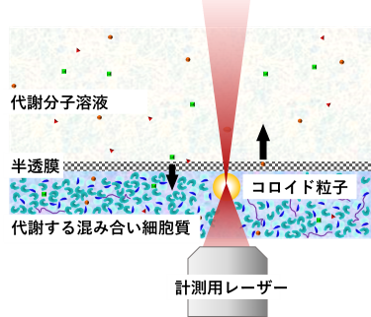
To investigate this transition, we developed an experimental platform in which cytoplasm extracted from living cells is confined within a semipermeable chamber (Fig.8). By continuously supplying small metabolites such as ATP while removing metabolic waste through the membrane, we can sustain metabolic activity for extended periods even outside the cell. This enables us to isolate the physical properties of the cytoplasm from the complexity of the cell as a whole.
Using tracer particles embedded in the cytoplasm, we quantify the nonequilibrium fluctuations generated by metabolic activity and investigate how these active forces determine the material properties
of the intracellular environment. Our long-term goal is to identify universal
physical principles by which living cells maintain the cytoplasm in an
active, fluid state, thereby revealing a common physical signature of living
matter across diverse cell types.
Related information: Prof. Daisuke Mizuno's Lab Website